Introduction
Finding reliable information online can feel harder than ever. Search engines give you long lists of links, social platforms show mixed opinions, and AI chatbots sometimes answer without showing where the information came from. For students, bloggers, marketers, researchers, and business owners, this creates one big problem: how do you find useful answers quickly while still checking the sources?
Perplexity AI helps solve this by working as an AI-powered search and answer platform. Perplexity’s help center describes it as an AI-powered search engine that helps users discover and interact with information, while providing answers supported by citations from reputable sources.
The main benefit is speed with source visibility. Instead of opening many tabs and manually comparing every page, users can ask a question and receive a summarized answer with cited sources. This makes the tool useful as an AI research tool, AI search engine, AI answer engine, AI productivity tool, source citation AI platform, and online research assistant.
In this guide, we will explore how Perplexity AI works, who should use it, its best features, practical use cases, limitations, and how to use it properly for smarter research.
How Perplexity AI Helps with Online Research
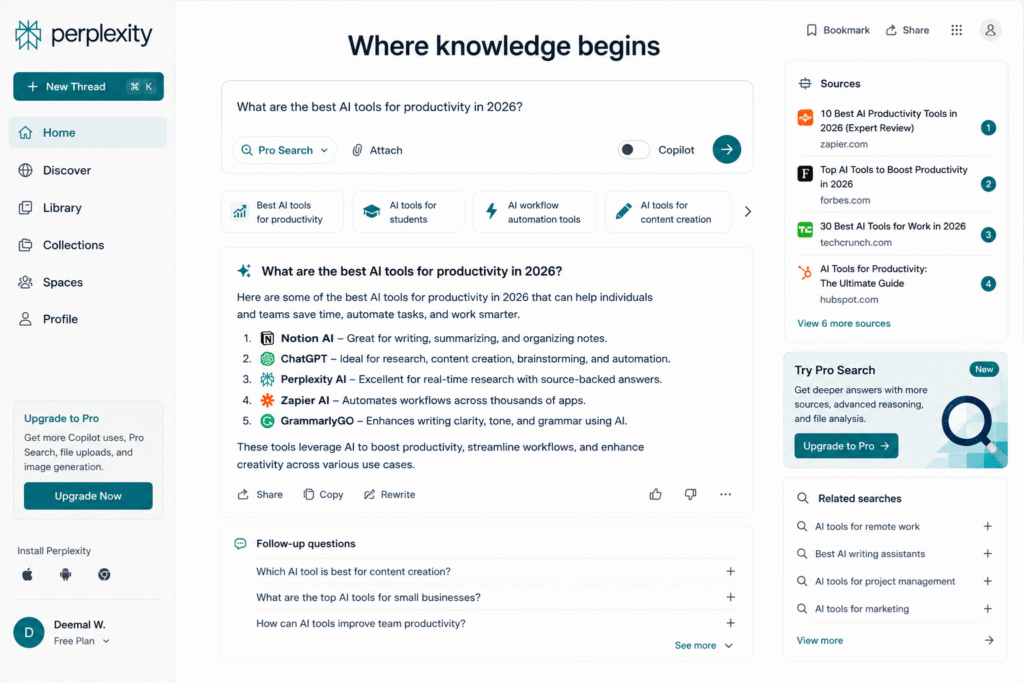
Perplexity AI is designed to reduce the time users spend searching, opening links, reading long pages, and comparing sources. When a user asks a question, the system searches the internet in real time and gathers information from relevant sources. Perplexity’s help guide says its answers include citations that link back to original sources, which helps users verify facts and explore deeper.
This is useful because research is not only about getting an answer. It is about understanding where the answer came from. A normal AI chatbot may give a clear response, but if the source is missing, users may not know whether the answer is reliable. An AI answer engine with citations gives users a better starting point.
For example, a content writer researching “best AI tools for productivity” can quickly collect an overview, compare different tools, and open sources for deeper reading. A student can explore academic topics faster. A marketer can research competitors, trends, and audience questions before writing a blog post.
As an AI research tool, Perplexity AI is especially helpful when users need quick explanations backed by source links.
Key Features of Perplexity AI
Source-backed answers
One of the strongest features of Perplexity AI is citation-based answering. Perplexity says responses are supported by citations from sources such as news organizations, academic publications, and established content sources.
This makes it useful as a source citation AI platform. When writing a blog, report, or research summary, citations help users check the original information before using it. This is important for E-E-A-T because Google values helpful, accurate, trustworthy content.
However, users should still open the sources and verify important claims. Citations improve transparency, but they do not remove the need for human review.
Real-time AI search
Perplexity AI works well as an AI search engine because it can search current web information. Its help center explains that it searches the internet in real time to gather insights from sources and provide answers with source transparency.
This is useful for topics that change often, such as software tools, pricing, AI updates, market trends, business news, product features, and technology comparisons.
For example, if you are writing about a new AI tool, a normal older article may already be outdated. Real-time search helps you check newer information before publishing.
Pro Search for deeper research
Perplexity also offers Pro Search. Its help center describes Pro Search as more like a knowledgeable search assistant than a traditional keyword search, with citations and transparency included in answers.
This can be helpful for detailed research questions. Instead of asking only simple factual questions, users can ask complex questions that need comparison, reasoning, or multi-source review.
Examples include:
- Which AI research tools are best for students?
- What are the pros and cons of a software platform?
- How does one product compare with another?
- What are the latest trends in a specific industry?
- What sources support a particular claim?
Internal knowledge search
For teams, Perplexity includes Internal Knowledge Search. The help center says this feature allows Pro and Enterprise users to search across internal files alongside the web, with file citations showing where internal information came from.
This can be valuable for businesses that store reports, policies, research documents, meeting notes, or internal guides. Instead of manually searching many files, teams can ask questions and receive answers grounded in internal documents and web sources.
Who Should Use Perplexity AI?
Perplexity AI is useful for many types of users who need fast, source-backed research.
| User Type | How Perplexity AI Helps |
|---|---|
| Bloggers | Research topics, collect sources, and verify claims |
| Students | Understand academic topics and find source links |
| Marketers | Research competitors, tools, trends, and keywords |
| Business owners | Explore market information and product comparisons |
| Researchers | Get fast overviews before deeper source review |
| Content teams | Improve factual accuracy and source discovery |
As an AI productivity tool, it helps users reduce the time spent switching between search tabs. As an online research assistant, it helps turn broad questions into organized answers.
For more similar tools, you can check our internal guide on AI tool.
Best Ways to Use Perplexity AI
To get better results from Perplexity AI, ask specific questions. A vague prompt gives a broad answer, while a focused prompt gives more useful research.
Instead of asking:
“What is AI?”
Ask:
“What are the best AI tools for small business productivity in 2026, and what are their main use cases?”
This gives the AI answer engine better direction.
A simple workflow:
- Start with a clear research question.
- Read the summarized answer.
- Open the cited sources.
- Check dates and source quality.
- Compare multiple sources.
- Save useful links.
- Use the findings in your own writing.
- Add proper citations before publishing.
This workflow helps prevent shallow research. The tool can speed up discovery, but the final judgment should come from you.
Pros and Limitations
Perplexity AI has strong benefits, but users should also understand its limits.
Pros:
- Gives fast answers with citations
- Helps reduce manual research time
- Works well for current topics
- Useful for bloggers, students, and marketers
- Supports follow-up questions
- Can help with internal knowledge search for teams
Limitations:
- Sources still need manual checking
- AI summaries can miss context
- Not every cited source is equally authoritative
- Some advanced features may require paid access
- Sensitive or high-stakes topics need extra verification
Research on AI search engines has also warned that source-cited AI answers can still have limitations, including citation accuracy and factual reliability issues. This means Perplexity AI should be used as a research assistant, not as a replacement for critical thinking.
FAQ
What is Perplexity AI?
Perplexity AI is an AI-powered search and answer platform that helps users ask questions, receive summarized answers, and check cited sources.
Is Perplexity AI an AI research tool?
Yes. It works as an AI research tool because it helps users research topics, find sources, summarize information, and verify answers faster.
Is Perplexity AI different from a normal search engine?
Yes. A normal search engine usually gives a list of links. Perplexity AI provides summarized answers with citations, making it closer to an AI answer engine.
Can Perplexity AI help bloggers?
Yes. Bloggers can use it to research topics, find supporting sources, understand trends, and verify facts before writing content.
Does Perplexity AI show citations?
Yes. Perplexity says its answers include citations and links to original sources so users can verify the information.
Can Perplexity AI replace manual research?
No. It can speed up research, but users should still open sources, check accuracy, compare information, and use their own judgment.
Final Thoughts
Perplexity AI is a strong choice for anyone who wants faster, clearer, and more source-backed online research. It helps users move from a question to a useful answer without manually opening dozens of pages first.
As an AI research tool, it supports topic discovery and source checking. As an AI search engine, it helps find current information. As an AI answer engine, it summarizes information in a readable way. As an online research assistant, it helps bloggers, students, marketers, and business teams save time.
The best way to use Perplexity is to ask focused questions, review the cited sources, verify important claims, and use the insights to create better content. If your workflow depends on research, this tool is worth testing.