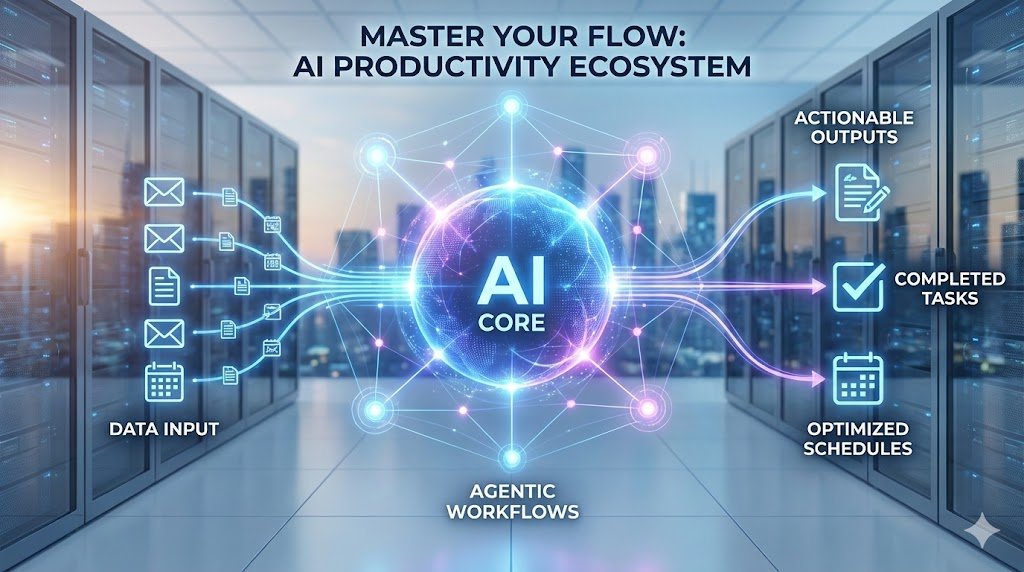
Have you ever reached the end of a grueling ten hour workday only to realize that most of your time was swallowed by “work about work”? In 2026, the digital landscape has become increasingly cluttered with notifications, fragmented data, and endless administrative loops. Statistics from recent industry reports suggest that the average knowledge worker still spends nearly 60% of their day on coordination and manual data entry rather than deep, creative tasks. This is where the strategic implementation of ai productivity tools becomes a non-negotiable asset for anyone looking to reclaim their time and mental energy.
The promise of artificial intelligence has moved beyond simple chat interfaces. We are now in an era where software does more than just answer questions; it anticipates needs and executes complex sequences with minimal human intervention. This guide is designed to navigate the current explosion of technological advancements, providing a roadmap for professionals and business owners who want to move from being “busy” to being truly productive. We will explore how modern systems are evolving to handle everything from intricate project management to autonomous decision-making.
By the end of this article, you will understand how to build a personalized tech stack that leverages the most advanced ai productivity tools available today. We will break down the differences between basic automation and the next generation of intelligent agents, ensuring you have the actionable knowledge to master your workflow. Whether you are a solopreneur or leading a global team, the value promise here is simple: more output, higher quality, and significantly less stress.
Revolutionizing Your Daily Routine with AI Productivity Tools
The first step in mastering your flow is recognizing that traditional time management techniques often fail because they don’t account for the cognitive load of switching between different platforms. When you integrate ai productivity tools into your core operations, you aren’t just adding a new app; you are installing a layer of intelligence that connects your calendar, your inbox, and your project boards into a cohesive ecosystem.
Current trends show that the most effective users of these technologies are those who treat AI as a digital partner rather than a search engine. This means setting up systems that can summarize hour-long meetings in seconds, prioritize your most important emails, and even draft initial responses based on your unique tone of voice. The goal is to eliminate the “blank page” syndrome and the “inbox anxiety” that plagues modern professionals.
Here are the 7 best ways to master your flow using ai productivity tools:
-
Deploy Agentic AI for Deep Research: Goal-oriented agents can handle competitor analysis and data collection autonomously without constant human intervention.
-
Implement Smart Scheduling Assistants: Eliminate back-and-forth emails by using AI that automatically checks your availability and suggests the best meeting times.
-
Use AI-Driven Meeting Intelligence: Turn hour-long calls into concise action items and summaries in seconds using automated note-takers.
-
Adopt Predictive Email Management: Prioritize your inbox and draft high-quality responses based on your unique tone to beat “inbox anxiety.”
-
Build a Unified AI Ecosystem: Use ai workflow tools to connect your CRM, project boards, and marketing platforms into one cohesive, automated system.
-
Automate Complex Data Categorization: Use machine learning to organize files and information instantly, ensuring you spend zero time on manual data entry.
-
Leverage Real-Time Performance Analytics: Move away from static monthly reports and use live AI dashboards to make agile, data-driven decisions every minute.
The Shift Toward Autonomous Operations
One of the most significant changes we have seen recently is the move away from rigid, rule-based automation. In the past, you had to tell a computer exactly what to do step by step. Today, the latest ai productivity tools use large language models and machine learning to understand the context of a task. If a client emails you requesting a meeting, the system doesn’t just notify you; it checks your availability, suggests a time, and prepares a briefing document on that client’s previous interactions.
- Implement smart scheduling assistants to reduce back and forth emails.
- Use AI-driven note-takers to ensure no action item is ever missed during a call.
- Apply automated categorization to your file management systems for instant retrieval.
Scaling Efficiency with Agentic AI Tools
As we look deeper into high-level strategy, we encounter a new category of technology: agentic ai tools. Unlike standard software that requires constant prompting, agentic systems are designed to be goal-oriented. You provide a high-level objective, such as “research the top five competitors in the fintech space and create a comparison report,” and the agent determines the necessary steps to complete the task autonomously.
These agentic ai tools represent the bridge between human intent and digital execution. They can browse the web, interact with APIs, and even troubleshoot their own errors. For a content strategist or a digital marketer, this means being able to delegate the heavy lifting of data collection and preliminary analysis to a digital workforce that never sleeps. This allows the human element to focus on high-level strategy and creative direction.
Building Your Autonomous Digital Workforce
To truly benefit from agentic ai tools, you must learn the art of objective-setting. It is no longer about “how” to do the work, but “what” the desired outcome should be. Companies that have successfully integrated these agents report a 40% increase in operational speed within the first six months. This is because these tools can handle multi-step processes that previously required several different team members to coordinate.
- Identify repetitive research tasks that take up more than three hours of your week.
- Deploy an autonomous agent to handle the data gathering and initial synthesis.
- Review the output and provide feedback to “train” the agent for future iterations.
Exploring the ethics of autonomous agents
Optimizing Business Processes via AI Workflow Tools
While individual tools are powerful, the true magic happens at the organizational level through the use of ai workflow tools. These systems are the “connective tissue” of a modern business. They allow different pieces of software to talk to each other, ensuring that data flows seamlessly from your CRM to your marketing platform and finally to your accounting software.
The beauty of ai workflow tools is their ability to identify bottlenecks that a human eye might miss. By analyzing the speed and efficiency of various tasks, these platforms can suggest optimizations or even automatically reroute tasks to the team member with the most capacity. This creates a “fluid” organization that can adapt to changing demands in real time.
Integrating Disparate Systems for Maximum Impact
A common mistake many businesses make is “siloing” their AI. They might use one tool for writing and another for coding, but the two never interact. By utilizing comprehensive ai workflow tools, you create a unified stream of information. For example, when a new lead is captured via a web form, the system can automatically research the lead’s company, score the lead based on your criteria, and then assign a personalized outreach task to your sales team.
- Map out your current manual processes to find where data “gets stuck.”
- Use low-code or no-code platforms to link your favorite apps into an intelligent chain.
- Monitor the performance of these workflows weekly to ensure they are delivering the expected ROI.
Advanced Techniques for Content and Creative Management
For those in creative fields, the integration of ai productivity tools has changed the nature of “the craft.” It is no longer about spending hours on tedious editing or formatting. Instead, it is about directing the AI to handle the foundational work so the creator can add the “human polish.” In 2026, the most successful creators are those who have mastered the “cyborg” approach to production.
Using agentic ai tools in the creative process can involve everything from generating mood boards based on a text description to performing deep-dive SEO audits on a draft article before it is even finished. This ensures that every piece of content produced is not only high-quality but also technically optimized for the current search algorithms.
Leveraging Real-Time Data for Better Decisions
One of the most powerful features of modern ai productivity tools is their ability to process vast amounts of real-time data. Instead of relying on monthly reports that are outdated by the time they reach your desk, you can now have dashboards that update every minute. This allows for agile decision-making that can pivot based on a trending topic or a sudden shift in market sentiment.
- Set up automated alerts for industry keywords to stay ahead of the curve.
- Use AI to analyze customer feedback across multiple social channels simultaneously.
- Automate the creation of monthly performance reports to save dozens of hours.
Technical Requirements for a Future-Proof Tech Stack
When building your ecosystem of ai productivity tools, it is vital to consider the infrastructure they sit on. Compatibility and security should be your top priorities. As more data is processed by these systems, ensuring that your customer information and proprietary strategies remain private is essential.
Furthermore, the scalability of your ai workflow tools is what will determine your long-term success. You want systems that can grow with you, moving from handling a few dozen tasks a day to managing thousands as your business expands. This requires a focus on platforms with robust APIs and a proven track record of uptime and support.
Prioritizing Security and Data Integrity
As you deploy more agentic ai tools into your business, you are essentially giving software the keys to your digital kingdom. This is why choosing reputable providers is critical. Look for tools that offer enterprise-grade encryption and clear policies on how your data is used for model training.
- Conduct a security audit of any new tool before integrating it into your main workflow.
- Use multi-factor authentication for all platforms that handle sensitive data.
- Regularly back up your automated workflows to ensure business continuity.
OpenAI security and progress guidelines
| Tool Category | Primary Benefit | Recommended Focus |
|---|---|---|
| Personal Assistants | Time reclamation | Inbox and calendar management |
| Agentic Systems | Task autonomy | Deep research and complex execution |
| Workflow Connectors | System integration | Data synchronization and bottleneck removal |
FAQ
What are the best ai productivity tools for beginners in 2026?
For those just starting, it is best to focus on tools that integrate directly into your existing software, such as AI extensions for your browser or your email client. These provide immediate value without a steep learning curve.
How do agentic ai tools differ from regular AI chatbots?
While a chatbot responds to prompts, agentic ai tools are capable of planning and executing a series of steps to achieve a goal. They can “think” through a problem and use external tools to solve it.
Can ai workflow tools replace human project managers?
No, these tools are designed to augment project managers. They handle the tracking and data entry, allowing the human manager to focus on team dynamics, leadership, and high-level strategy.
Is it expensive to implement these ai productivity tools?
The market has become very competitive, and many tools offer tiered pricing. Most professionals find that the time saved by these tools far outweighs the monthly subscription costs.
Do I need coding skills to use agentic ai tools?
Most modern tools are designed with “no-code” interfaces, meaning you can set up complex automations using visual builders or natural language instructions.
How do I ensure my data is safe when using these platforms?
Always check for SOC2 compliance and read the data privacy agreements. High-quality tools allow you to opt-out of having your data used for training their models.
What is the most important factor in a successful AI workflow?
Clear communication and well-defined objectives. If you don’t know what you want the outcome to be, even the best ai workflow tools will struggle to provide value.
How often should I update my AI tech stack?
The field is moving fast, so a quarterly review of your tools and workflows is recommended to ensure you are still using the most efficient options available.
Embracing the Future of Autonomous Achievement
As we have explored, the transition into a high-efficiency environment is no longer a luxury but a necessity in a world defined by information overload. By strategically selecting your ai productivity tools and integrating them into a cohesive system, you aren’t just working faster; you are working smarter. The emergence of agentic ai tools has handed us a level of leverage that was previously unimaginable, allowing small teams to produce the output of large corporations.
The journey toward mastering your flow begins with a single step: identifying the one repetitive task that drains your energy most and finding an automated solution for it today. As you become more comfortable with these technologies, you can expand into more complex ai workflow tools that handle your entire business logic. Remember that the goal of all this technology is to free you from the mundane, giving you the space to innovate, create, and lead.
The digital landscape will continue to evolve, but the principles of efficient workflow remain the same. Focus on clarity, prioritize integration over isolation, and always keep your high-level goals at the forefront of your strategy. By doing so, you will stay ahead of the curve and maintain a competitive edge in any industry. Now is the time to audit your current habits and start building the autonomous future you deserve.
To see how these systems are evolving through standardized connections, you can explore the agentic ai tools framework known as the Model Context Protocol.