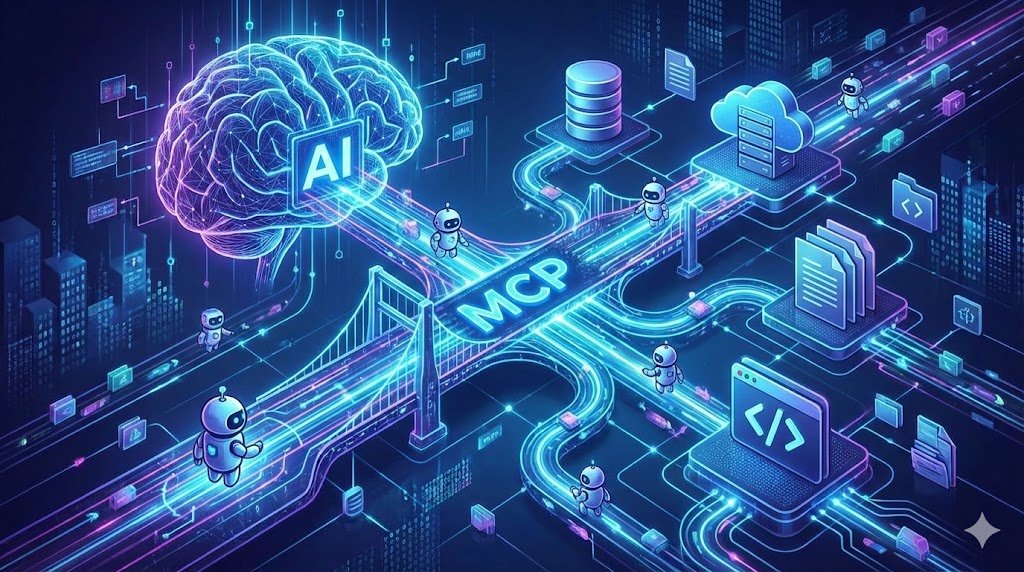
Imagine buying a brand new printer, bringing it home, and realizing you have to write the driver software yourself before it can print a single page. That sounds absurd in the world of hardware, yet this is exactly the situation developers and businesses face today with Artificial Intelligence. We have incredibly powerful Large Language Models (LLMs) that can write poetry, solve complex math, and reason through logic, but they are often trapped inside a chat window, isolated from the data that actually matters to your business.
In this guide, we will dive deep into what this protocol is, how the MCP architecture functions, and why it is the missing piece for building the next generation of AI tools. Whether you are a developer looking to streamline your workflow or a business leader aiming to leverage standardized AI context, understanding this shift is crucial for staying ahead.
What is the Model Context Protocol?
The Model Context Protocol (MCP) is an open standard that enables developers to build secure, two-way connections between data sources and AI-powered tools. Historically, if you wanted an AI application to access a specific dataset, you had to write a custom integration specific to that AI provider’s API. If you switched AI providers, you had to rebuild the integration.
MCP changes this dynamic entirely. It establishes a universal language that both the AI application (the client) and the data source (the server) understand. Once a data source is set up as an MCP server, any MCP-compliant AI client can connect to it instantly. This eliminates the need for endless custom connectors and allows developers to write an integration once and use it everywhere.
This standardization is critical because data is the fuel for AI. Without a seamless way to connect LLMs to data, models are prone to hallucinations because they lack context. By providing a standardized AI context, the Model Context Protocol ensures that AI agents have the specific, real-time information they need to answer questions accurately and perform tasks correctly.
The Core Components of MCP Architecture
To truly understand the power of this technology, we need to look under the hood at the MCP architecture. The system is designed to be modular and extensible, consisting of three primary components that work together in harmony.
MCP Hosts
The Host is the application where the AI interaction takes place. This could be a desktop application like the Claude Desktop app, an Integrated Development Environment (IDE) like Cursor, or a custom-built AI interface. The Host is responsible for managing the connection and facilitating the user experience. It decides which tools and resources are available to the AI at any given time.
MCP Clients
The Client acts as the bridge within the Host application. It maintains 1:1 connections with servers. The Client is responsible for sending requests to the server and receiving resources, prompts, or tool execution results back. In the context of intelligent agents, the client acts as the dispatcher, knowing which server holds the right information for the task at hand.
MCP Servers
This is where the magic happens. MCP servers are lightweight programs that expose specific data or capabilities. An MCP server might expose a folder on your computer, a database, or a third-party API like Linear or GitHub. The beauty of MCP servers is that they define their own resources and tools. They tell the Client, “Here is what I can do,” and the Client makes those capabilities available to the AI.
| Feature | Traditional Integration | MCP Approach |
|---|---|---|
| Development | Custom code for every AI provider | Write once, work everywhere |
| Scalability | Linear effort (1 new tool = 1 new code) | Exponential potential (1 server = many clients) |
| Maintenance | High (API changes break connectors) | Low (Standardized protocol) |
| Data Access | Often requires uploading data to cloud | Local or remote secure access |
Why Anthropic MCP Matters for the Industry
While the concept of a standard protocol isn’t new, the momentum behind Anthropic MCP is significant. Anthropic, the creators of the Claude AI model, open-sourced this protocol to prevent the AI industry from becoming a walled garden. By championing an open standard, Anthropic MCP encourages a diverse ecosystem where developers are not locked into a single vendor.
When a major player like Anthropic pushes for a standardized AI context, it signals to the market that interoperability is the future. This is similar to how the Language Server Protocol (LSP) revolutionized code editors. Before LSP, every editor needed custom support for every programming language. After LSP, any editor could support any language that had a language server. Anthropic MCP aims to do the exact same thing for AI context.
This initiative allows smaller developers and large enterprises alike to contribute to a shared library of connectors. You do not have to wait for OpenAI or Google to build a connector for your niche internal database. You can build an MCP server for it today, and it will work with any MCP-compliant tool tomorrow.
How to Connect LLMs to Data Securely
Security is often the biggest barrier to adopting AI agents in an enterprise setting. Companies are rightfully hesitant to upload sensitive proprietary data to third-party cloud servers just to get an AI summary. The Model Context Protocol addresses this by favoring a client-host model that can run locally.
When you use the Model Context Protocol, the data flow is controlled. You can run MCP servers locally on your machine. When you query the AI, the relevant context is fetched from your local server and sent to the model for processing, but the control remains in your hands. You are not blindly giving an AI access to your entire cloud infrastructure; you are giving it access to a specific, defined gateway.
This ability to connect LLMs to data without compromising on security protocols is a game-changer. It means a developer can build an agent that accesses a production database to generate reports without needing to copy that database into a vector store or a third-party embedding service. The data stays where it belongs, and the standardized AI context is provided on-demand.
Building the Next Generation of Intelligent Agents
We are moving past the phase of “chatting” with AI and entering the phase of “working” with AI. Intelligent agents are software entities that can perceive their environment, reason about how to achieve a goal, and take action. The Model Context Protocol is the nervous system for these agents.
For an agent to be intelligent, it needs tools. In the MCP world, these tools are provided by servers.
- Coding Agents: By connecting a filesystem MCP server and a GitHub MCP server, an agent can read your code, understand the project structure, and propose pull requests.
- Support Agents: By connecting a Zendesk MCP server and a Notion MCP server, an agent can look up documentation and past tickets to draft replies to customers.
- Data Analysis Agents: By connecting a PostgreSQL MCP server, an agent can write and execute SQL queries to answer questions like “What was our churn rate last month?” without a human needing to write the code.
The power of AI agents lies in their ability to chain these tools together. Because MCP architecture is standardized, an agent can seamlessly switch between checking your calendar (Google Calendar MCP) and booking a meeting room (Office 365 MCP) in a single workflow.
Real-World Use Cases for MCP
To make this concrete, let’s look at how the Model Context Protocol is being applied in real-world scenarios today.
1. Automated Software Engineering
Developers are using MCP servers to give AI permission to run terminal commands and edit files. Instead of copying and pasting code errors into a chatbot, the AI has direct access to the console output. It sees the error, reads the file causing it, patches the code, and runs the test again. This loop is only possible because the Model Context Protocol provides a structured way for the AI to interact with the local development environment.
2. Legal and Compliance Auditing
Law firms are dealing with massive amounts of discovery documents. By using a local PDF reading MCP server, they can have intelligent agents scan thousands of local files for specific keywords or clauses without ever uploading those sensitive files to a public cloud storage bucket for processing. The standardized AI context ensures the AI understands the legal terminology and document structure.
3. Enterprise Knowledge Management
Large companies have data scattered across Confluence, Jira, Slack, and Sharepoint. A “Universal Search” agent can be built using MCP servers for each of these platforms. When an employee asks, “What is the status of Project X?”, the agent queries all connected servers, aggregates the context, and provides a unified answer. This solves the “information silo” problem that plagues modern organizations.
The Developer Experience: Getting Started
If you are a developer, the barrier to entry for the Model Context Protocol is surprisingly low. The ecosystem allows you to write MCP servers in Python or TypeScript/Node.js.
To get started, you typically install the MCP SDK. You then define the “resources” your server will expose. A resource might be a file path or a database row. Next, you define “tools,” which are executable functions the AI can call. Finally, you connect your new server to a host like the Claude Desktop app by editing a simple configuration file.
Once connected, the Model Context Protocol handles the handshake. The AI model immediately “knows” what tools are available. You do not need to fine-tune the model or write complex system prompts explaining the API. The protocol handles the description and schema exchange, making the integration of AI agents almost plug-and-play.
Overcoming Challenges with MCP Adoption
While the Model Context Protocol is revolutionary, it is not without challenges. The primary hurdle right now is adoption. For this to become the true standard, we need more tool creators (like Salesforce, HubSpot, and Microsoft) to build official MCP servers. Currently, the community is filling the gap with open-source adapters, but official support will be the turning point.
Another challenge is context window management. Even with standardized AI context, LLMs have a limit on how much information they can process at once. Developers must be clever about how their MCP servers summarize and retrieve data so they do not overwhelm the AI agents with too much noise. Effective retrieval strategies are still necessary to ensure the right data is fed into the protocol.
FAQ
1. What is the Model Context Protocol used for?
The Model Context Protocol is used to standardize how AI models connect to external data and tools. It allows developers to build a single integration (an MCP server) that works with multiple AI clients, facilitating better data access and automation.
2. Is Anthropic MCP different from the standard MCP?
No, they are effectively the same. Anthropic MCP refers to the protocol that Anthropic open-sourced. They are the primary drivers behind the standard, but it is designed to be an open ecosystem for any AI provider to use.
3. How do MCP servers differ from traditional APIs?
Traditional APIs are designed for code-to-code interaction and vary wildly between services. MCP servers wrap these APIs in a standardized layer that is specifically designed for AI consumption, including resource definitions and prompt templates.
4. Can I use the Model Context Protocol for private data?
Yes, this is one of its strongest use cases. Because MCP architecture supports local execution, you can run servers on your own machine or private network, allowing AI agents to access sensitive data without it leaving your secure environment.
5. Do I need to be a programmer to use MCP?
Currently, setting up MCP servers requires some technical knowledge, usually involving command-line usage. However, as the ecosystem matures, we expect to see one-click installers and user-friendly interfaces for non-technical users.
6. Which AI models support MCP currently?
At the moment, the primary support comes from Anthropic’s Claude (via the Claude Desktop app) and developer tools like Cursor and Zed. However, because it is an open standard, support is rapidly expanding to other platforms and models.
7. How does MCP help with AI hallucinations?
By providing a direct, standardized AI context, MCP gives the AI access to factual, real-time data. Instead of guessing an answer, the AI can query the relevant server to get the exact facts, significantly reducing the rate of hallucinations.
Embracing a Connected AI Future
The era of the isolated chatbot is coming to an end. As businesses and developers demand more utility from their artificial intelligence investments, the need for a robust connectivity layer has never been clearer. The Model Context Protocol provides that layer. It offers a secure, scalable, and standardized way to connect LLMs to data, transforming passive chatbots into active, capable assistants.
By adopting this standard, we are not just making integrations easier; we are laying the groundwork for a future populated by helpful intelligent agents. These agents will be able to navigate our digital lives with the same fluency that we do, automating the mundane and surfacing the insights that matter.
Whether you are building the next great AI tool or simply trying to get your internal systems to talk to each other, the path forward involves the Model Context Protocol. It is time to stop building bridges one by one and start using the universal standard that connects everything. The future of AI is context-aware, connected, and built on MCP.
As you refine your AI strategy, it is also crucial to ensure your digital presence is ready for the future; take time to compare AI search optimization tools to find the right solutions for your needs.