Introduction
Research is one of the most time-consuming parts of academic writing, content creation, and professional decision-making. Whether you are a student, researcher, writer, or business professional, finding credible papers and understanding them quickly can be difficult. You may spend hours searching databases, opening multiple studies, reading abstracts, and trying to decide which sources are worth using.
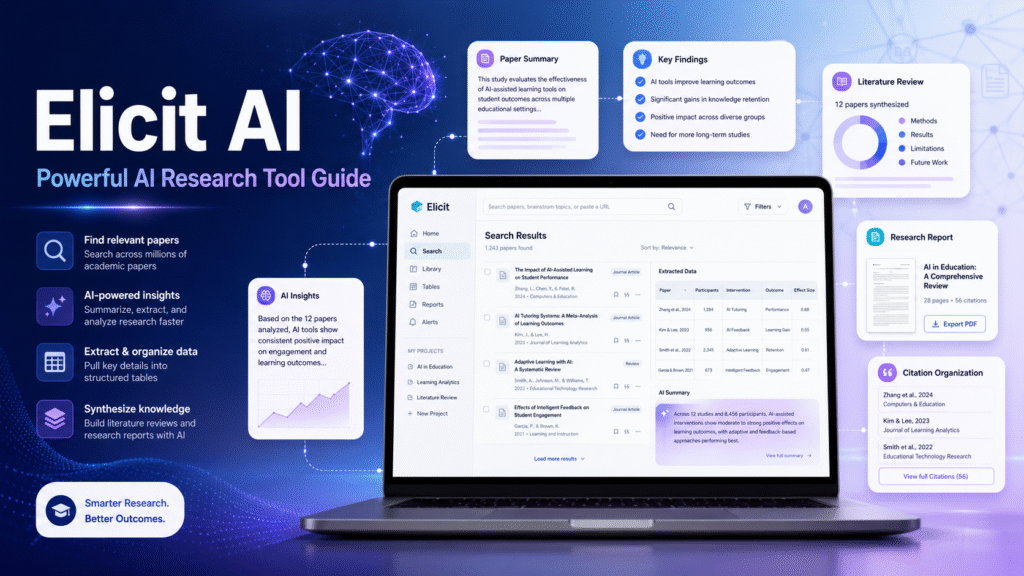
Elicit AI helps make this process easier by using artificial intelligence to support academic research. It helps users discover papers, review summaries, extract useful details, and organize findings more efficiently. Instead of manually checking every source from the beginning, users can move faster from a research question to useful evidence.
This makes the platform helpful for literature reviews, academic writing, research reports, and evidence-based content. It does not replace human judgment, but it can reduce repetitive research work and help users focus on analysis.
In this guide, we will explore how Elicit AI works, its main features, best use cases, limitations, and how to use it properly for better research results.
How Elicit AI Supports Research Work
Elicit AI works by helping users search and analyze academic papers based on a research question. Instead of only showing a normal list of search results, it organizes information in a more useful way. This is important because research is not just about collecting links. It is about understanding what each paper says, whether the evidence is relevant, and how it supports your topic.
For example, if you are researching how artificial intelligence affects education, the platform can help you find relevant studies and compare their key findings. This saves time during the early research stage, especially when you need to review many sources.
As an AI research tool, it is useful for people who need academic evidence but do not want to spend too much time sorting through unrelated papers. Students can use it for assignments and thesis preparation. Content writers can use it to find credible sources. Professionals can use it to understand industry trends, technology, healthcare topics, or scientific developments.
The biggest advantage is speed. Instead of reading every paper fully at the start, users can first scan summaries, methods, findings, and important details. Then they can choose which papers deserve deeper reading.
Key Features That Make It Useful
Academic paper discovery
One of the main features of Elicit AI is paper discovery. Users can enter a research question and get related academic papers. This is more useful than a broad web search because the results are focused on research-based sources.
For example, instead of searching “AI in healthcare” on a general search engine, you can ask a more specific question such as “How does AI improve diagnosis accuracy in healthcare?” A clearer question usually gives better results.
This feature is useful for:
- Finding academic papers faster
- Exploring new research topics
- Building a source list for writing
- Understanding what has already been studied
- Comparing different research findings
Literature review support
A literature review usually requires searching, screening, reading, comparing, and summarizing multiple studies. This can take days or weeks depending on the topic. Elicit AI can make this process more manageable by helping users review papers in a structured way.
As an AI literature review tool, it can help organize research evidence so users can understand patterns across different studies. For example, you may want to know which papers support a certain idea, which studies have strong methods, and which ones have limitations.
However, users should not blindly trust every AI-generated summary. The best method is to use the tool for first-level screening and then manually check the most important papers.
Paper summaries and extracted details
Another useful feature is summarization. Long research papers can be difficult to understand quickly, especially when they include technical language. The platform can help highlight important points such as the research objective, method, sample, result, and conclusion.
This is useful when you need to compare many sources before writing. For example, a student preparing a thesis can quickly check whether a paper is relevant before spending time reading the full document.
A good workflow is:
- Search using a clear research question.
- Review the listed papers.
- Check summaries and key findings.
- Save the most useful sources.
- Open important papers and verify details.
- Use the evidence in your own writing.
Who Should Use Elicit AI?
Elicit AI is useful for different types of users. It is not only for academic researchers. Anyone who needs credible information can benefit from it.
| User Type | How It Helps |
|---|---|
| Students | Find sources for assignments, essays, and thesis work |
| Researchers | Speed up paper screening and evidence review |
| Writers | Add credible research support to articles |
| Educators | Prepare teaching materials with academic backing |
| Healthcare users | Review medical or scientific studies carefully |
| Business teams | Research trends, competitors, and technical topics |
For content creators, this tool can improve article quality because it helps bring evidence into blog posts. For researchers, it can reduce repetitive manual work. For students, it can make academic source discovery easier.
Best Practices for Better Results
To get better results, start with a specific question. A vague query will produce broad results, while a focused query will give more useful papers.
Instead of asking:
“What is climate change?”
Ask:
“How does climate change affect rice production in South Asia?”
This gives the system better direction and improves the quality of results.
You should also check the original sources before using claims in your article or assignment. AI can summarize information, but it may miss context or details. Always review the paper title, authors, publication date, methods, and conclusion.
Here are a few tips:
- Use clear and specific research questions.
- Do not rely only on summaries.
- Check the original paper before citing.
- Compare multiple studies before making a claim.
- Save useful sources in an organized way.
- Use AI output as support, not final proof.
For more similar platforms, you can visit our guide on AI research tools.
Pros and Limitations
Like any AI platform, this tool has both strengths and limitations.
Pros:
- Saves time during research
- Helps find relevant academic papers
- Supports literature review workflows
- Makes paper summaries easier to scan
- Helps organize findings
- Useful for academic and professional writing
Limitations:
- AI summaries need manual checking
- Some features may require a paid plan
- Not every topic will have enough strong papers
- Users still need critical thinking
- It should not replace full paper reading
The best way to use it is as a research assistant. Let it speed up searching and organizing, but make final decisions yourself.
FAQ
What is Elicit AI?
Elicit AI is a research platform that helps users find academic papers, review summaries, extract information, and organize evidence for writing or analysis.
Is it useful for students?
Yes. Students can use it to find sources for essays, reports, assignments, and thesis work. It is especially useful during the early research stage.
Can it help with literature reviews?
Yes. It can support literature review workflows by helping users search papers, compare findings, and identify useful sources faster.
Can it summarize research papers?
Yes. The platform can help summarize important information from academic papers, but users should still check the original source before citing it.
Is it a replacement for manual research?
No. It helps reduce manual work, but human review is still important. Users should verify important claims and read key papers fully.
Who can benefit from this tool?
Students, academic researchers, writers, educators, healthcare professionals, and business teams can all benefit from using it for evidence-based research.
Final Thoughts
Elicit AI is a helpful solution for anyone who wants to research faster and work with academic papers more efficiently. It can support paper discovery, summaries, literature review tasks, and evidence organization without making the process too complicated.
The key is to use it wisely. Start with a clear question, review the suggested papers, verify the original sources, and use the findings to strengthen your own writing. For students, writers, and professionals, this can save time and improve the quality of research-based content.