Introduction
Financial research can take a lot of time. Investors, analysts, students, and finance teams often need to check company financials, compare competitors, read filings, review investor presentations, track KPIs, and understand market data before making decisions. Doing all of this manually can be slow and confusing.
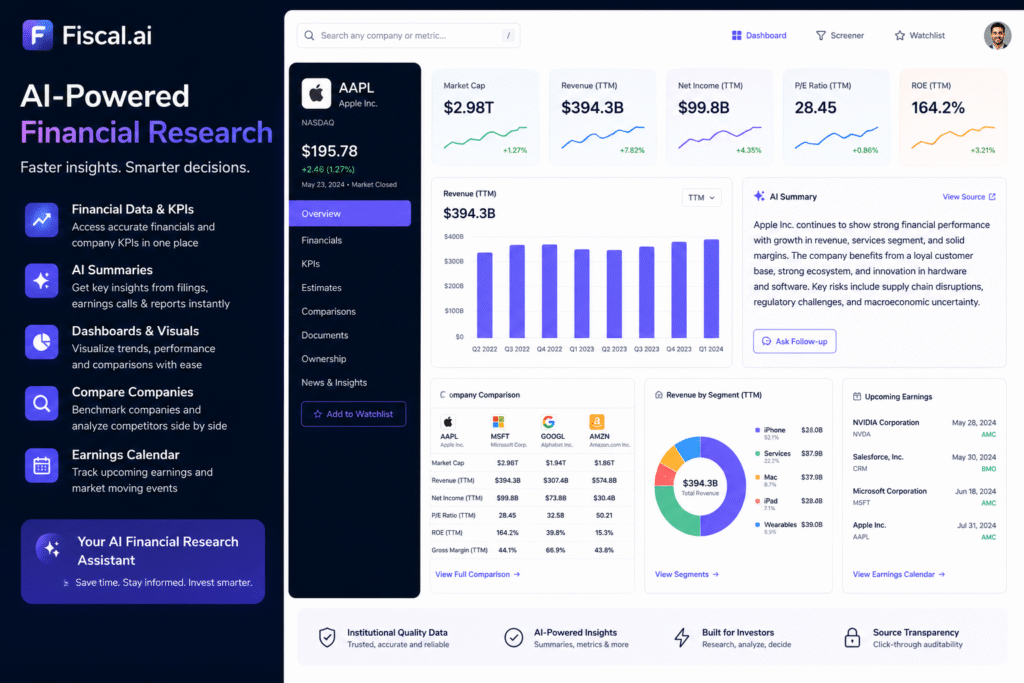
Fiscal AI helps simplify this process by bringing financial data, AI summaries, dashboards, charts, company KPIs, and research tools into one platform. The official Fiscal.ai website describes it as a modern financial data platform with global data for public equities, ETFs, and funds. It also highlights features such as AI summaries, KPI data, dashboards, data visualization, estimates, ownership data, investor relations content, earnings calendar, and click-through auditability.
This makes Fiscal AI useful for users who want to research companies faster and organize financial information more clearly. It can work as an AI finance tool, AI stock research tool, AI investment research tool, financial research assistant, AI market analysis tool, and stock analysis AI platform.
In this guide, we will explore what Fiscal AI does, who should use it, its main features, practical use cases, limitations, and how to use it properly for better research.
How Fiscal AI Helps Financial Research
Fiscal AI is designed to make company research faster and more organized. Instead of jumping between annual reports, investor relations pages, spreadsheets, financial news, and charting tools, users can review important financial information in one workspace.
The platform states that it helps users understand company financials, screen new investments, summarize content, visualize data, compare ideas, and organize dashboards. This is useful because finance research is not only about collecting data. It is about finding the right data, understanding it, and comparing it with other companies or market benchmarks.
For example, if a user wants to analyze a software company, they may need revenue growth, gross margin, operating income, free cash flow, customer metrics, valuation ratios, analyst estimates, and earnings call commentary. A normal workflow could take hours. Fiscal AI can make the early research stage faster by bringing these items into a cleaner platform.
As an AI finance tool, it can support users who need quick research summaries and structured financial data. As an AI stock research tool, it can help investors compare public companies and review business fundamentals more efficiently.
Key Features of Fiscal AI
Financial data and company fundamentals
One of the main strengths of Fiscal AI is access to global financial data. The platform says it provides accurate fundamental data for global stocks, ETFs, and funds.
This is important because financial research depends on data quality. If the numbers are wrong or incomplete, the analysis can become misleading. A good AI investment research tool should make it easier to access clean data and review the source behind important metrics.
Users can review company financials, performance trends, and market information in one place. This can help with equity research, competitor analysis, portfolio review, and business model comparison.
AI summaries for faster understanding
Long filings, earnings transcripts, investor presentations, and company updates can be difficult to review quickly. Fiscal AI includes AI summaries that help users understand important information faster.
This feature is useful for investors and analysts who need to review many companies. Instead of reading every document from start to finish, users can first scan summaries and then open the most important sources for deeper review.
A financial research assistant is most valuable when it reduces repetitive reading while still helping users verify the original information.
KPI data and business segment insights
Fiscal AI also highlights company-specific business segments and KPIs. This matters because traditional financial statements do not always show the full business story.
For example, a streaming company may need subscriber data, average revenue per user, churn rate, or ad revenue trends. A retail company may need same-store sales, store count, average order value, or inventory metrics. A software company may need annual recurring revenue, net retention, or customer growth.
By showing KPI data, Fiscal AI can help users understand what actually drives a business.
Dashboards and data visualization
The platform includes dashboards and visualization tools for tracking watchlists, portfolios, financial metrics, and company comparisons. Fiscal.ai says users can build dashboards, visualize data, and compare ideas more easily.
This makes it useful as an AI market analysis tool. Charts and dashboards can help users identify trends faster than raw tables alone.
For example, a user can compare revenue growth, margin trends, and valuation multiples across several companies in the same industry. This can make competitor research easier and more visual.
Who Should Use Fiscal AI?
Fiscal AI is useful for people who need financial data and company analysis.
| User Type | How Fiscal AI Helps |
|---|---|
| Individual investors | Research public companies and compare stocks |
| Finance students | Practice analysis using real company data |
| Equity analysts | Speed up company research and benchmarking |
| Portfolio managers | Track watchlists, KPIs, estimates, and updates |
| Content writers | Add financial context to market articles |
| Business teams | Analyze competitors and industry trends |
The Corporate Finance Institute says Fiscal.ai, formerly FinChat, is an AI-powered equity research platform with institutional-quality financial data and analytical tools. CFI also notes that the platform includes tools for historical data collection, competitor comparisons, and benchmarking.
This makes Fiscal AI especially suitable for users who want to learn or practice professional research workflows.
How to Use Fiscal AI Effectively
To get better results, start with a clear research goal. Do not only search a company name and stop there. Ask a specific question.
For example:
- How has revenue growth changed over the last five years?
- What are the main KPIs driving this business?
- How does this company compare with its closest competitors?
- What did management say in the latest earnings call?
- Are margins improving or declining?
- What risks are mentioned in recent filings?
A clear question helps the platform produce more useful insights.
A simple workflow:
- Choose a company or sector.
- Review the financial summary.
- Check revenue, margins, cash flow, and debt.
- Review company-specific KPIs.
- Compare competitors.
- Read AI summaries of important documents.
- Verify important numbers from the source.
- Build a dashboard or watchlist for future tracking.
For more similar tools, you can check our internal guide on AI finance tool.
Pros and Limitations
Fiscal AI has many useful benefits, but users should understand its limits.
Pros:
- Saves time during company research
- Helps compare public companies
- Supports financial dashboards and charts
- Includes AI summaries for faster review
- Provides company-specific KPI data
- Useful for investors, analysts, and students
Limitations:
- It should not be used as personal financial advice
- Users still need to verify important data
- Some advanced features may require a paid plan
- AI summaries may miss context
- Investment decisions still require human judgment
This is important because financial tools can support research, but they should not make decisions for the user. Always verify data, check original filings, and consider risk before making financial decisions.
FAQ
What is Fiscal AI?
Fiscal AI is an AI-powered financial data and research platform that helps users analyze public companies, review financials, summarize content, compare ideas, and build dashboards.
Is Fiscal AI an AI finance tool?
Yes. It works as an AI finance tool because it helps users understand financial data, company fundamentals, market trends, and investment research workflows.
Can Fiscal AI help with stock research?
Yes. It can be used as an AI stock research tool because it provides company data, KPI insights, dashboards, summaries, and comparison tools.
Is Fiscal AI useful for students?
Yes. Finance students can use it to practice company analysis, financial modeling research, competitor benchmarking, and investment research workflows.
Can Fiscal AI replace a financial analyst?
No. It can support analysts by reducing repetitive work, but it cannot replace human judgment, critical thinking, risk analysis, or professional decision-making.
Is Fiscal AI financial advice?
No. Fiscal AI is a research platform. Users should verify data and make independent decisions. It should not be treated as personal investment or financial advice.
Final Thoughts
Fiscal AI is a strong option for users who want to make financial research faster, cleaner, and easier to organize. It brings company financials, KPIs, AI summaries, dashboards, charts, and comparison tools into one research platform.
As an AI investment research tool, it can help investors and analysts review public companies more efficiently. As a stock analysis AI platform, it can support company comparisons, KPI tracking, and market research. As a financial research assistant, it can reduce manual work and help users focus more on analysis.
If you are writing finance content, studying equity research, or comparing public companies, Fiscal AI is worth exploring. Start with one company, review its financial data, compare it with competitors, and use the AI summaries to speed up your research process.